
Mass-Producing Learning: The Hidden Cost to Teachers and Students


Teaching in 2025 is hard. Typically, the global pandemic which halted and changed our world five years ago is accused of creating our current reality, but teachers know the education system already had cracks in its foundation long before.
Standardized testing has shaped schooling for decades. Test scores determine federal funding, and districts have aligned standards, curriculum, and pacing guides to maximize results Over time, academic success became defined almost entirely by data points. In many ways, this is not new—our public education system was originally designed, in part, to prepare children for an industrial workforce built on efficiency, conformity, and compliance. Today, that legacy lives on. Our education system resembles a factory–one where policymakers trim budgets, efficiency is prized over humanity, and both teachers and students are treated as mass-produced products. In a season when the world encourages gratitude, reflection, and renewal, many teachers instead feel assembly-lined, inspected, and boxed in.
It seems like scripted curricula are being advertised as the cure for declining literacy rates and stagnant standardized test scores. Yet in my experience, these programs create passive students–children who are prepared for a test rather than invited into deep and joyful learning.
Scripted lessons are typically written for already-proficient learners, yet they are most often mandated in schools serving students with the greatest needs—a system choice that reinforces a kind of educational assembly line, where the students furthest from opportunity receive the most rigid, least responsive instruction. This approach doesn’t close gaps; it mechanizes them..
When you Google “curriculum,” AI defines it as “a structured program of study and a guide for teaching, outlining the knowledge, skills, content, and learning experiences students are expected to gain in an educational program or course.”
Yet somewhere along the way, the guide became the teacher. The curriculum became the content. The script becamethe learning experience for students. What was meant to be a blueprint has hardened into the machine itself, standardizing everything in its path. And teachers—highly trained professionals—became operators on someone else’s assembly line.
Like many colleagues, I arrive early and stay late. Not to dream up creative, responsive lessons, but to click through links, print district-approved tasks, and ensure I’m on the exact same page as every teacher on my grade level. Collaboration used to mean shared questions, shared problem-solving, shared curiosity. Now it means staying in lockstep, never veering from the conveyor belt. I feel more like a technician troubleshooting a system designed by someone who has never met my students than an educator shaping human beings. The loss of agency—the loss of joy—has been one of the most painful parts of this season.
Are there benefits? Sure. Having a premade lesson can lighten the load. But at what cost? Teaching is both art and science. With scripted programs, the science remains—but the art is slowly being stripped away. The more standardized the system becomes, the more teachers are expected to function like interchangeable parts—replaceable, regulated, and tightly controlled. My creativity, once the heartbeat of my practice, now feels like contraband.
Stakeholders cannot claim concern about a national literacy crisis while investing millions in scripted curricula and digital modules. Policymakers cannot lament stagnant test scores when teachers are asked to move students along grade after grade without the time, resources, or flexibility to address foundational gaps. I will boldly claim: our nation’s scores will continue to decline as long as learning is reduced to test preparation and teaching is reduced to reading from a script. No factory—no matter how efficient—can nurture curiosity, resilience, empathy, or intellectual joy.
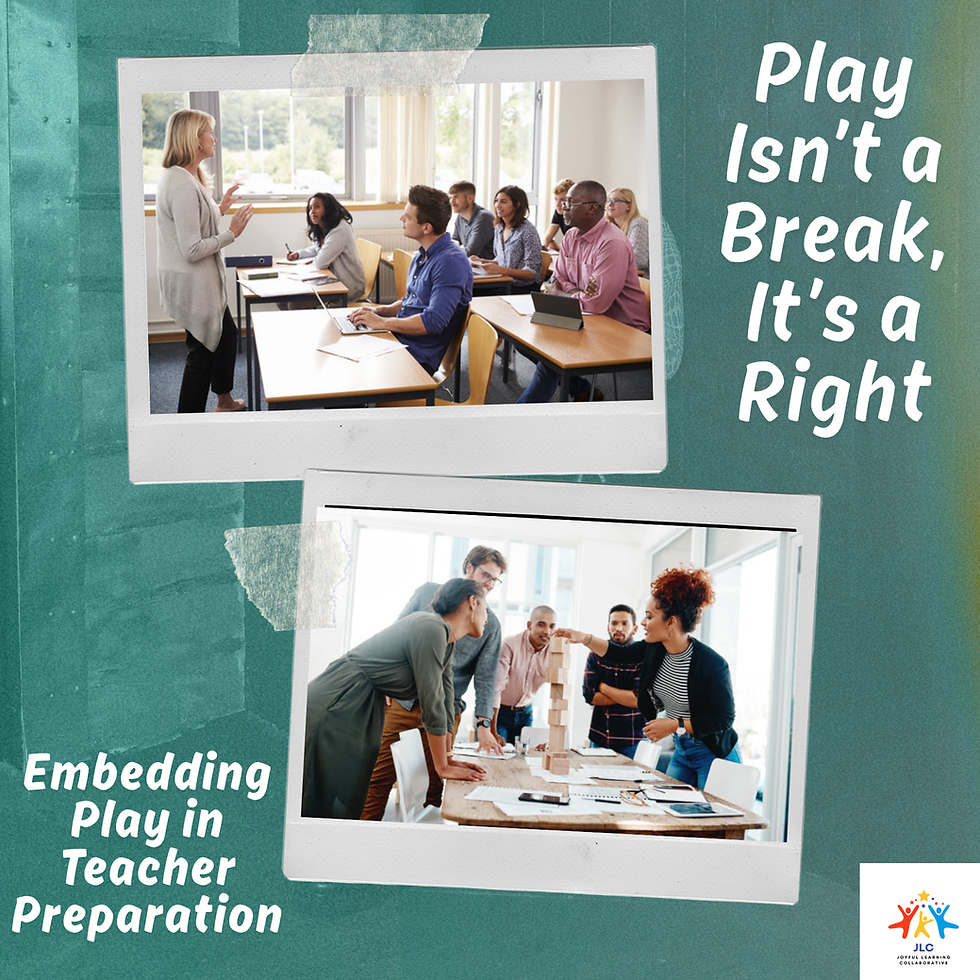
Research shows how powerful and influential play can be for young learners–but what about teachers? We need professional play, too. Factories don’t offer play—they offer repetition. But teaching has never been about repetition; it has always been craft. We need the figurative sandbox: space to tinker, time to iterate, room to fail forward, and permission to rebuild our craft. The Joyful Learning Collaborative calls this Joyful Learning for students, but it must extend to educators as well. Joy is not a luxury; it is a condition for good teaching.
Teachers graduate with degrees focused on understanding child development, designing meaningful learning experiences, and adapting instruction for diverse learners. Yet too often, we arrive at schools only to be handed a script and a spot on the production line. The very training meant to help us build, shape, and create suddenly becomes irrelevant—because the “machine” tells us exactly what to do. It’s demoralizing. It’s dehumanizing. And it is driving good teachers out.
How can we truly support students when their entire experience with content is determined by multimillion-dollar curriculum companies? Great teachers have always been translators—taking content and making it engaging, accessible, and relevant. But translation becomes impossible when our work is limited to pushing buttons and reading lines. A machine can deliver information; only a teacher can make meaning.
The education system is weakened, compromised, and in desperate need of reimagining. Is the solution shrinking districts so students and teachers receive the support they need? Is it reducing the outsized influence of standardized tests? I don’t claim to know the singular answer. But I do know this: rigid, scripted curricula cannot be the heart of our classrooms.
Honor our degrees.
Honor our judgment.
Honor our humanity.
Let us create.
Let us build.
Let us play.
If we want joyful learners, we must first reclaim joyful teaching.

Comments